What Is Ceremonial Cacao? A Producer's Answer
Ceremonial cacao isn't a certification. It's a specific set of sourcing and processing choices most brands skip. A craft producer explains what separates genuine from labeled.
Quick answer: Ceremonial cacao is 100% whole cacao, no added sugar, no emulsifiers, no defatting, made from single-origin beans, minimally processed to preserve the plant's full chemistry, and used as a deliberate daily or ritual practice. It is not a regulated term. Whether a product deserves the name depends entirely on how it was made.
The Definition
Ceremonial cacao is whole cacao — the ground bean with its fat intact, minimally processed, from a single named origin, with nothing added that would alter its fundamental chemistry. Prepared as a hot drink. Consumed with attention as a practice, not as a treat.
That is the working definition used by serious producers. It is not a legal standard. No government body certifies 'ceremonial grade.' No trade association enforces the term. Any brand can print it on a label.
This gap between what the word originally meant and what it now covers on the shelf is the whole problem with the ceremonial cacao category.
I have been making ceremonial cacao at Mandala Naturals since 2008, sourcing exclusively from the Maya Mountain region of Belize through Uncommon Cacao's traceable supply chain, stone-grinding for 6 days, selling a product that contains one ingredient. I have strong opinions about what the word should mean because I've spent nearly two decades understanding the difference.
The Four Criteria That Determine Authenticity
Authentic ceremonial cacao requires four things: single-origin sourcing with verifiable transparency, whole cacao with fat content intact, no alkalization or emulsifiers, and particle size achieved through extended stone grinding rather than rapid industrial refining. Products that fail any of these may be high-quality cacao products. They are not ceremonial cacao in the original sense.
1. Single-Origin Sourcing With Verified Transparency
Ceremonial cacao begins with cacao worth treating ceremonially. That means a specific growing region, not 'Central and South America' which is blended commodity language, with a verifiable fermentation protocol, confirmed Fair Trade or better economics, and a sourcing partner who publishes the data.
Blended cacao from anonymous origins can be organically certified and still tell you nothing about what you're drinking. Origin determines flavor character, mineral profile, and the integrity of every claim downstream about quality.
At Mandala, every batch comes from the Maya Mountain region of Belize, sourced through Uncommon Cacao, a certified B Corp that publishes full transparency reports: price paid per pound, fermentation documentation, cooperative information. You can read it at uncommoncacao.com. We named them because that transparency is something you can verify. We are not asking you to trust us. We are showing you the data.
2. Whole Cacao With Intact Fat
Cacao contains roughly 50% fat by weight. That fat, cacao butter, is also the most economically valuable part of the bean. Most processed cacao, powder, supplements, has had this fat partially or fully removed before sale, because the butter commands a premium when sold separately.
Ceremonial cacao keeps the butter. Not as a choice for palatability, but because removing it changes what the product is. The fat determines mouthfeel, carries flavor compounds, and is structurally part of the plant's chemistry.
A ceremonial cacao product that dissolves easily in cold water has almost certainly been defatted. That doesn't make it useless. It is not ceremonial cacao in the traditional sense.
3. No Alkalization, No Emulsifiers, No Sweeteners
Dutch processing is the standard for making cocoa powder palatable and consistent. It also destroys a large share of the flavanol content. Research in the Journal of Agricultural and Food Chemistry (Miller et al., 2008) documented flavanol losses of 60 to 90% in heavily Dutched cocoa compared to natural-process cacao.
Ceremonial cacao is not alkalized. Not emulsified with lecithin. Not flavored with vanilla. Not sweetened. The bitterness is part of what the product communicates. Take it away and you have changed the message.
4. Extended Stone Grinding
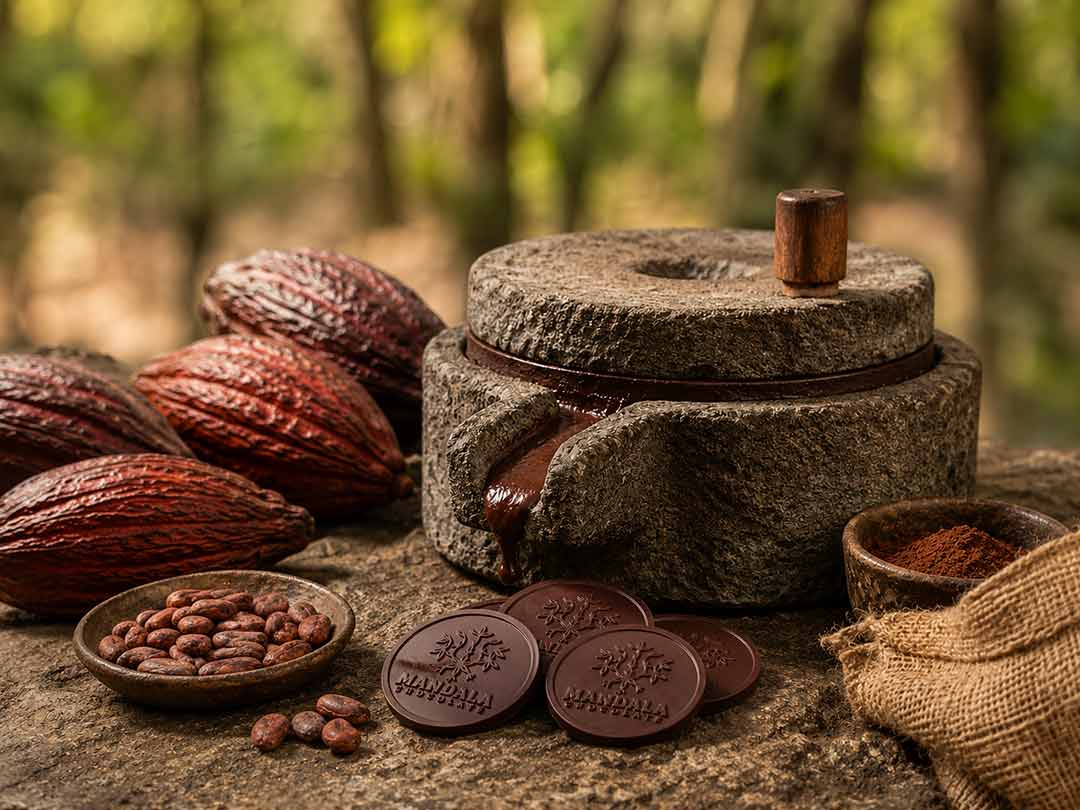
Most commercial chocolate is refined for 2 to 4 hours in high-speed steel ball mills. Premium craft producers run 24 to 72 hours. At Mandala we grind for 6 days: 72 hours of cacao alone on the stone mill, then 72 hours after ingredients are added.
Extended stone grinding reduces particle size below the sensory detection threshold. It drives off volatile fermentation acids that would leave sharpness in the finish. It distributes cacao butter evenly around every particle, producing a mouthfeel that faster processing cannot replicate.
Taste the result within 10 seconds of a side-by-side comparison and the difference is clear.
What Most Brands Get Wrong
The ceremonial cacao market has expanded faster than its standards. Three compromises appear most often: origin transparency (blended cacao sold as ceremonial), fat content (defatted powder positioned as ceremonial grade), and grinding time (short industrial refining in place of extended stone milling). These are usually economic compromises rather than deceptive ones. They still produce a different product.
The economics of ceremonial cacao are not compatible with cheap prices. Single-origin sourcing costs more and limits supply. Six days of stone grinding is slow and throughput-constrained. Keeping cacao butter in the product means you cannot recapture its margin by selling it separately.
When a brand sells 'ceremonial cacao' for $14 per pound on Amazon with next-day delivery, one of three things is happening: the origin is blended or unknown, the processing is rapid, or the fat has been removed. Often all three.
This is not fraud. Many of these products are genuinely good cacao products. They are not ceremonial cacao in the sense the word originally described, and the marketing language rarely makes that distinction clear.
How to Evaluate Before You Buy
Four questions to ask before purchasing anything labeled ceremonial cacao:
- Where does the cacao come from, specifically? Look for a country and region, not a continent. 'Sourced sustainably from the tropics' means the origin is blended or unknown.
- Is it whole cacao or a powder? Whole ceremonial cacao comes as a solid disc or block that must be dissolved in hot water rather than cold. Instant-dissolving powder that works in cold liquid has been processed differently. Both have uses. They are not the same product.
- What is the ingredient list? Authentic ceremonial cacao lists one thing: cacao. Lecithin, natural flavors, sweeteners, coconut milk powder, all are formulated additions masking what the cacao alone would reveal.
- Can the producer describe the fermentation protocol? A producer who knows their cacao can tell you how long the beans were fermented, the type of vessel, and how they were dried. If the copy is generic, that information probably does not exist internally either.
What Mandala's Ceremonial Cacao Is
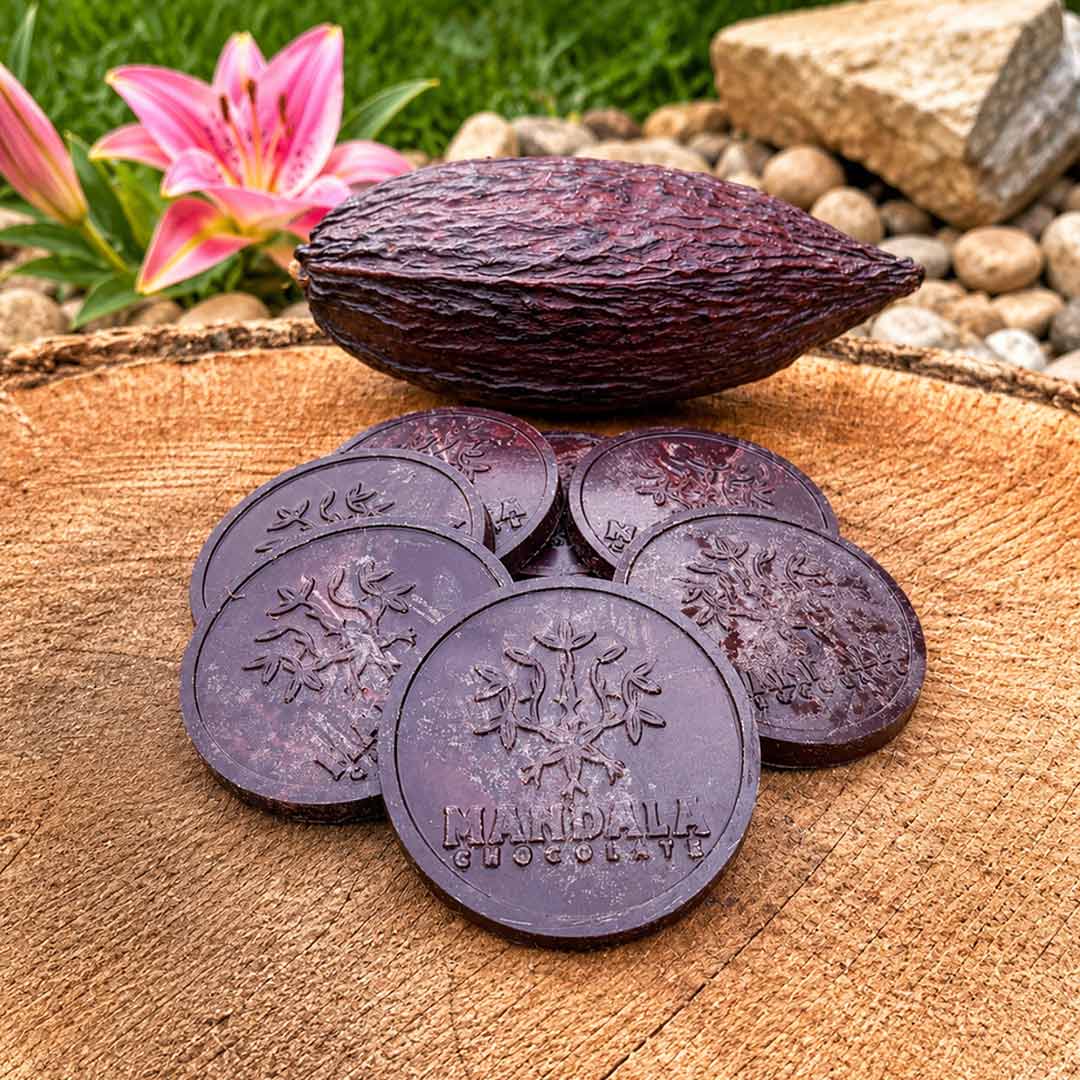
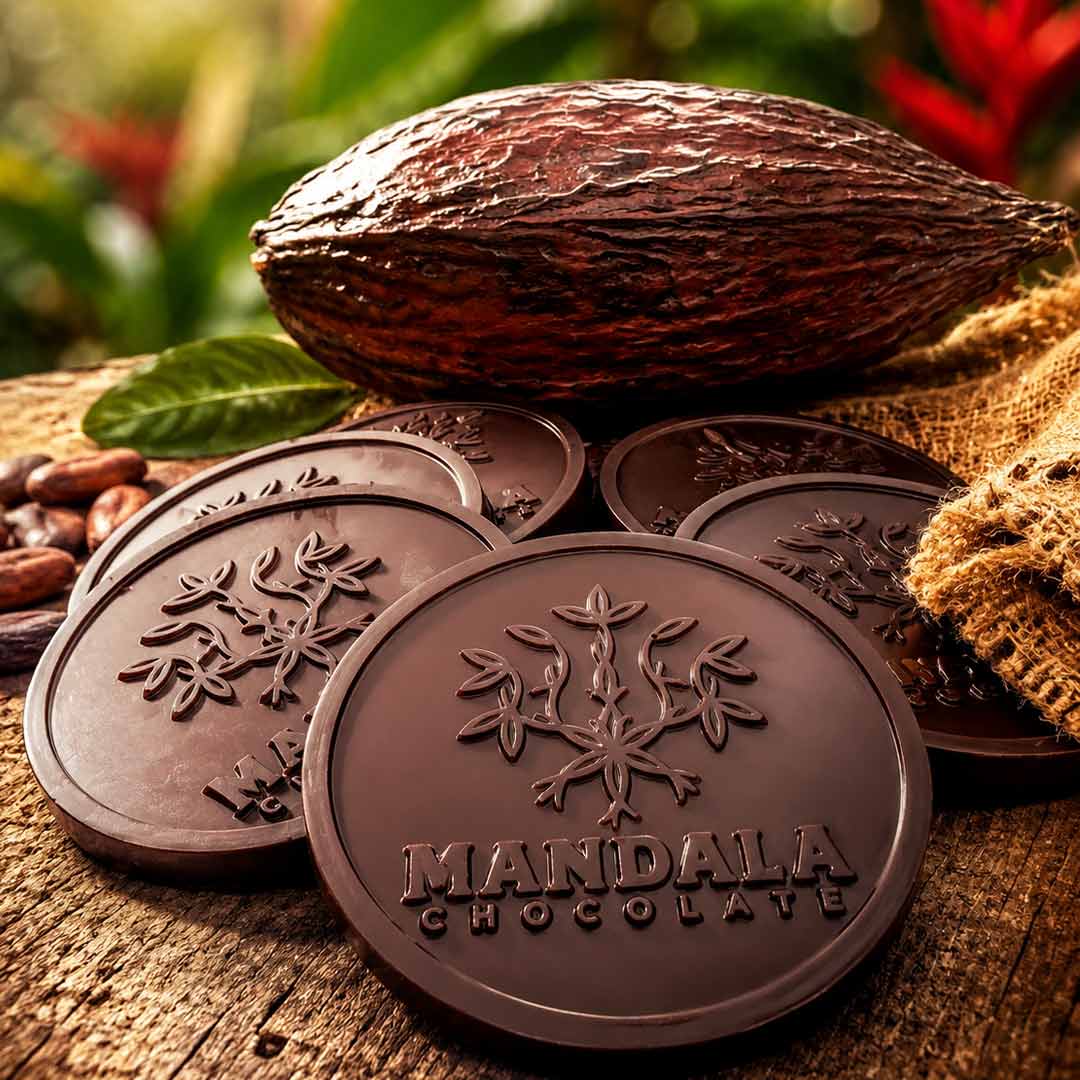
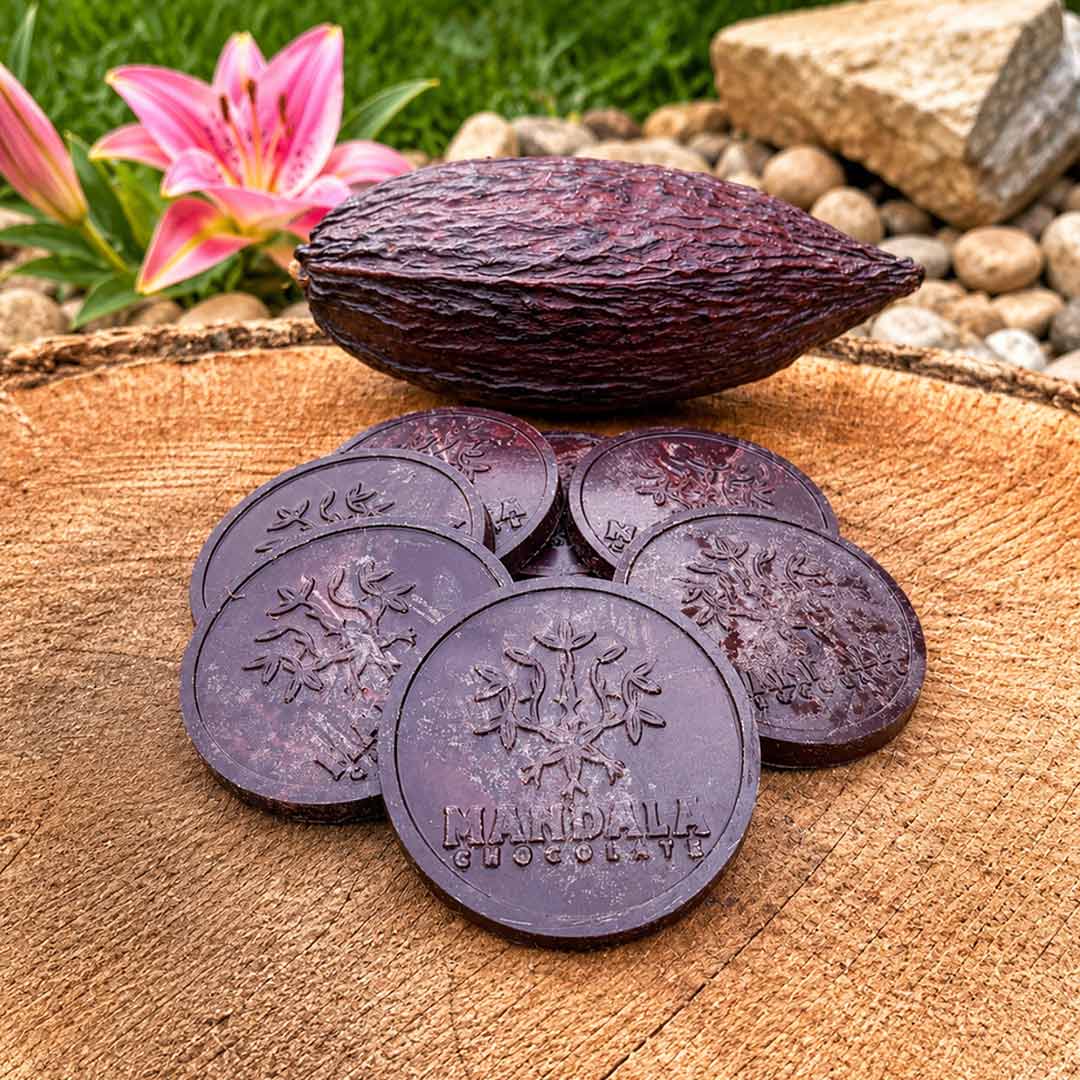
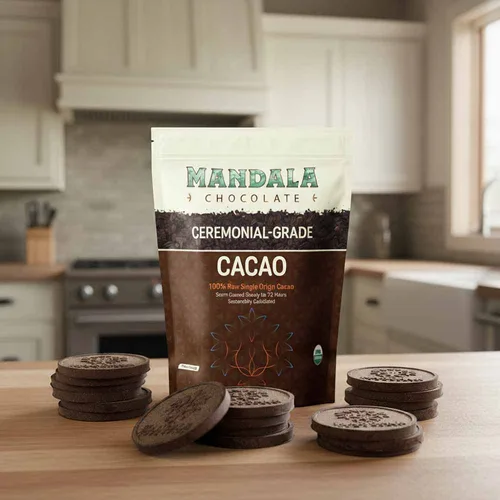
Mandala Naturals' ceremonial cacao is a single-ingredient product: 100% whole cacao from the Maya Mountain region of Belize, stone-ground for 6 days at their Craftory in Barnardsville, NC. USDA Organic, Fair Trade certified, B Corp certified, Non-GMO Project Verified. No added sugar, no emulsifiers, no flavoring. Sold as a 1-pound bag of 16 individual 1-ounce discs at $44.50.
Our ceremonial cacao is one ingredient: Maya Mountain Belize cacao, stone-ground for 6 days, formed into individual 1-ounce discs and packed 16 to a bag. Each disc is one standard serving. Drop it into hot water, stir, and drink. The format is deliberate. It keeps the preparation simple without making it instant, and pre-portioning each disc means you always know exactly what you're working with.
The flavor is bitter. Not the softened bitterness of a 70% dark chocolate bar, but the full, complex, astringent bitterness of cacao that has not been managed for palatability. It also has fruit notes, a brightness from the specific genetics of Maya Mountain Trinitario cacao, and a richness of mouthfeel that is entirely a function of the fat being where it belongs.
This is what ceremonial cacao has been for centuries in the regions where cacao grows: nourishment, ritual, relationship with the plant. Not a supplement. Not a dessert. A practice.
How to Use It
Drop one disc into 6 to 8 oz of water heated to 165 to 175°F. Not boiling. Stir until fully dissolved or blend for 30 seconds. Drink slowly.
Each disc is 1 ounce (28g), pre-portioned. Dose tiers:
Daily practice: half a disc / 0.5 oz / 14g. Standard ceremonial: 1 disc / 1 oz / 28g. Full ceremony: 2 discs / 2 oz / 56g.
The theobromine in cacao, a mild xanthine stimulant, becomes significant at full ceremony doses. Start at half a disc if you're new. Work up over one to two weeks.
Frequently Asked Questions
❓ What is ceremonial cacao?+
Ceremonial cacao is 100% whole cacao, the ground bean with its natural fat intact, from a single named origin, with no added sugar, emulsifiers, or defatting. Used as a hot drink in a deliberate daily or ritual practice. 'Ceremonial' is not a regulated certification. It describes a quality and intention of preparation.
❓ Is ceremonial cacao the same as raw cacao?+
No. 'Raw' implies cacao processed below a specific temperature threshold, a claim the industry has no standardized definition for, since fermentation itself generates substantial heat. Ceremonial cacao is minimally processed and not alkalized, but 'raw' is a marketing term, not a production standard. What matters is what was not done to the cacao: no Dutching, no defatting, no emulsification.
❓ Can I use ceremonial cacao every day?+
Yes. A daily dose of half a disc is sustainable as a morning ritual. The theobromine content at this dose produces a mild, sustained effect different from caffeine. Many people report that daily cacao practice replaces or reduces coffee over time.
❓ What does ceremonial cacao taste like?+
Bitter, the full, earthy, complex bitterness of cacao without the sweetening or fat removal that makes commercial chocolate approachable. Maya Mountain Belize cacao has fruit-forward top notes, a brightness that lifts the earthiness, with a long finish. The 6-day stone grind produces a mouthfeel substantially richer than powder-based preparations.
❓ How is ceremonial cacao different from cacao powder?+
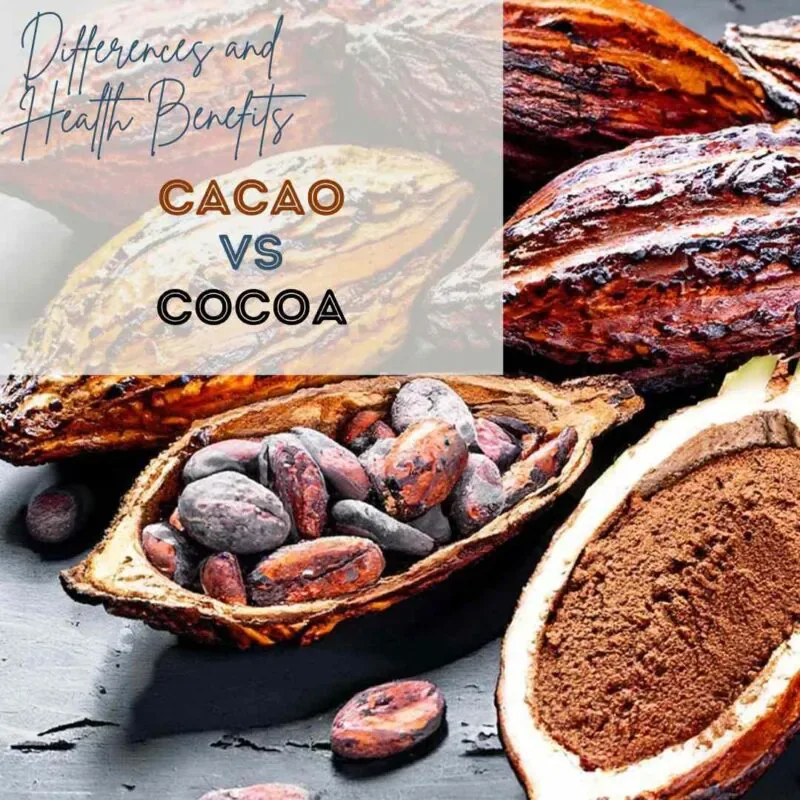
Cacao powder is defatted: the cacao butter has been pressed out, making it lighter and more soluble. Ceremonial cacao keeps its full fat content, which changes the mouthfeel, flavor depth, and the product's relationship to the plant's original chemistry. For a dedicated preparation practice, whole cacao is the appropriate form. For baking or smoothies, powder is often more practical.
❓ How do I know if a product is genuine?+
Four signals: a specific named origin (country and region, not continent), sold as whole cacao in solid disc or block form rather than a powder, a single-ingredient list, and a sourcing partner who publishes transparency data. Products that fail these tests may be high-quality. They are not ceremonial cacao in the traditional sense.
More from the Blog
Continue exploring cacao wellness