What Is Yacon Syrup? Glycemic Index, Benefits, and How It Works
Yacon syrup has a glycemic index of 1 and feeds gut bacteria with prebiotic inulin. Here's the science, a sweetener comparison table, and why it's in Mandala's functional bars.
Quick answer: Yacon syrup is a dark, naturally sweet syrup from the Andean yacon root (Smallanthus sonchifolius). Its glycemic index is approximately 1, near zero, because most of its carbohydrates are fructooligosaccharides (FOS), a prebiotic fiber that human digestive enzymes cannot break down into blood sugar. It tastes mildly sweet with a slight caramel quality.
What Yacon Is
Yacon (Smallanthus sonchifolius) is a tuberous root in the sunflower family, native to the Andean highlands of South America and cultivated as a food crop there for over a thousand years. The root resembles a sweet potato in appearance, reddish-brown skin, pale yellow flesh, but its internal chemistry is completely different.
Where most root vegetables store energy as starch, glucose chains that digestive enzymes break readily into blood sugar, yacon stores energy primarily as fructooligosaccharides. These short-chain carbohydrates are structurally inaccessible to the enzymes in the human small intestine. They reach the large intestine largely intact and become food for beneficial gut bacteria.
Yacon syrup is pressed from the root, then concentrated through dehydration. The result is thick, dark, mildly sweet, with a flavor somewhat like a lighter molasses.
Glycemic Index: The Key Number
Yacon syrup has a glycemic index of approximately 1, compared to 65 for table sugar and 35 for coconut sugar. This near-zero glycemic response occurs because yacon's primary carbohydrates, fructooligosaccharides, are not hydrolyzed by human digestive enzymes in the small intestine. The caloric contribution is also substantially lower: approximately 1.3 kcal per gram, versus 4 kcal per gram for sucrose.
The glycemic index measures how quickly a food raises blood glucose compared to pure glucose (GI = 100). A GI under 55 is generally classified as low. Yacon's GI of approximately 1 reflects the structural fact that its dominant carbohydrates are not absorbed as glucose.
This separates yacon from most "low-glycemic" sweetener claims, which often overstate their case. Agave syrup has a relatively low GI of 15 to 30 but contains high quantities of fructose, which carries its own metabolic considerations. Yacon's FOS are not fructose in the conventional sense. They are oligomers that pass the small intestine intact.
How Prebiotic Inulin Works in the Gut
The fructooligosaccharides in yacon syrup are prebiotic fiber. Upon reaching the large intestine, they are fermented selectively by Bifidobacterium and Lactobacillus species, producing short-chain fatty acids, principally butyrate, propionate, and acetate. Butyrate is the primary energy source for colonocytes, the cells lining the colon, and is associated with intestinal barrier integrity in published research.
Prebiotics are not probiotics. Probiotics are live cultures. Prebiotics are the substrate those cultures use. The FOS in yacon selectively feed Bifidobacterium and Lactobacillus while being less available to pathogenic strains. This selective action is the basis of the prebiotic classification.
Fermentation of FOS by gut bacteria produces three primary short-chain fatty acids:
- Butyrate: primary fuel for colonocytes; associated with intestinal barrier integrity
- Propionate: transported to the liver; involved in glucose regulation signaling
- Acetate: most abundant SCFA; used by peripheral tissues as an energy substrate
This is the established mechanism. It is why prebiotic fiber from yacon, chicory root, garlic, onion, and Jerusalem artichoke is associated with gut microbiome diversity improvements in controlled studies.
What the Clinical Studies Show
Two published studies are worth citing directly:
Madrigal-Santillán et al. (2006), Nutrition: Documented increases in Bifidobacterium populations and improved bowel function in subjects consuming yacon syrup. One of the earliest controlled human studies on yacon specifically.
Genta et al. (2009), Clinical Nutrition: A randomized controlled trial in women with insulin resistance and obesity. Subjects consuming yacon syrup daily for four months showed significant reductions in fasting serum insulin, body weight, and waist circumference compared to the placebo group. The researchers attributed effects primarily to the FOS content and the low glycemic load.
What these studies do not show: yacon as a treatment for insulin resistance, diabetes, or obesity. Single studies are not clinical proof of therapeutic effect. We cite them because they are published, real, and relevant. We do not cite them to claim yacon reverses anything.
The straight summary: yacon's prebiotic FOS content is well-documented, its near-zero glycemic impact is chemically explained, and two controlled human studies show measurable effects on gut microbiome composition and metabolic markers. More research would strengthen these findings.
Yacon vs. Other Sweeteners
| Sweetener | Glycemic Index | Prebiotic | Cal/gram | Primary Carbohydrate |
|---|---|---|---|---|
| Yacon syrup | ~1 | Yes (FOS/inulin) | ~1.3 | Fructooligosaccharides |
| Cane sugar | 65 | No | 4.0 | Sucrose |
| Coconut sugar | 35 | Minimal (~5% inulin) | 3.8 | Sucrose + fructose |
| Honey | 58 | No | 3.0 | Glucose + fructose |
| Agave syrup | 15-30 | No | 3.1 | High-fructose syrup |
| Monk fruit extract | 0 | No | ~0 | Mogrosides (non-caloric) |
| Erythritol | 0 | No | 0.2 | Sugar alcohol |
| Maple syrup | 54 | No | 2.6 | Sucrose |
Monk fruit and erythritol hit zero glycemic impact through different mechanisms: monk fruit is non-caloric; erythritol is a sugar alcohol metabolized differently. Yacon hits near-zero glycemic impact while also delivering prebiotic fiber activity. No other common sweetener does both.
Coconut sugar's inulin content (~5%) is real but marginal. It does not produce meaningful prebiotic activity at normal serving sizes. Yacon's FOS content, comprising 35 to 70% of its dry weight depending on growing conditions and processing, is the functional amount.
What Yacon Tastes Like in Stone-Ground Cacao
Yacon syrup has a mild, slightly caramel-adjacent sweetness, less sharp than cane sugar, longer in duration. In stone-ground cacao where particle size has been reduced over 6 days of milling, yacon integrates into the cacao matrix rather than competing with it. The result is a functional chocolate bar that reads as sweet but not sugary, the cacao's bitterness present and rounded, not suppressed.
Flavor integration is the practical reason we chose yacon for our functional bars over monk fruit or erythritol. Both achieve zero-glycemic sweetness. Both leave a flavor signature that competes with complex cacao in an extended stone grind.
Yacon's slight darkness, the caramel hint, the absence of synthetic brightness, sits behind the cacao's own character. You taste the Maya Mountain Belize origin first. The sweetness comes after, completing the bar without defining it. That is what a sweetener should do in a formulation built around cacao.
Why Mandala Uses It in Functional Bars
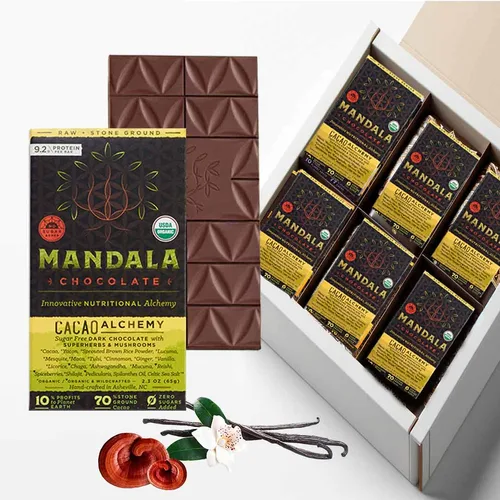
Cacao Alchemy and Appalachian Wild Chai are formulated around adaptogenic botanicals and wild-harvested herbs from Mandala Springs, our 67-acre certified organic forest farm. The formulation goal is nourishment, not indulgence. The sweetener had to be non-glycemic, prebiotic, and flavor-compatible.
Yacon met all three. Monk fruit and erythritol met the first but failed the third. Coconut sugar, which we use in our flavor-forward bars (Vanilla Orchid, Lavender Citrus, Cloud Forest), met the third but failed the first.
Using yacon is a formulation decision, not a marketing one. It costs more than coconut sugar. It is less familiar to most buyers than monk fruit. It requires explanation. We use it because it is the right ingredient for what these bars are supposed to be.
Both bars are sweetened with yacon syrup, stone-ground for 6 days, and contain wild-harvested adaptogens from Mandala Springs. USDA Organic, Fair Trade, B Corp certified, Non-GMO Project Verified.
Taste Cacao Alchemy | Taste Appalachian Wild Chai
Rob Lenfestey is the founder of Mandala Naturals, LLC. He has been formulating functional chocolate at the Mandala Chocolate Craftory in Barnardsville, NC since 2008.
Frequently Asked Questions
❓ What is yacon syrup?+
A dark, naturally sweet syrup from the Andean yacon root. Its primary carbohydrates are fructooligosaccharides, prebiotic fiber that digestive enzymes cannot break into blood sugar. Glycemic index: approximately 1.
❓ Is yacon syrup good for blood sugar?+
The evidence is encouraging. Yacon's FOS are not absorbed as glucose, so they do not directly raise blood sugar. A 2009 randomized controlled trial (Genta et al., Clinical Nutrition) found reduced fasting insulin in subjects consuming yacon syrup daily for four months. We are not medical practitioners. If you manage diabetes or insulin resistance, speak with your healthcare provider before treating yacon as a dietary intervention.
❓ Does yacon syrup cause digestive problems?+
For people unaccustomed to high prebiotic fiber intake, yacon can initially cause bloating or gas as the gut microbiome adjusts, the same response seen with inulin supplements, chicory root, and garlic. Starting with smaller amounts and increasing gradually minimizes this for most people.
❓ How is yacon different from agave?+
Agave has a relatively low GI (15 to 30) but achieves this through high fructose content, which carries separate metabolic considerations for those managing fructose sensitivity. Yacon's FOS are structurally different from fructose: they pass the digestive system intact and are not metabolized as simple sugars. They also have documented prebiotic activity that agave does not.
❓ Is yacon vegan and allergen-free?+
Yes. Derived from a root vegetable, no animal products involved. Mandala's bars containing yacon (Cacao Alchemy and Appalachian Wild Chai) are also free from gluten, dairy, and soy.
More from the Blog
Continue exploring cacao wellness