Why We Stone-Grind Cacao for 6 Days: The Physics and Flavor
Most chocolate is refined in 2 to 4 hours. At Mandala, we run the stone mill for 6 days. Here's what changes, why it matters, and what you taste in the finished bar.
Quick answer: Most commercial chocolate is refined for 2 to 4 hours in high-speed steel ball mills. Premium craft chocolate typically runs 24 to 72 hours. At Mandala, we stone-grind for 6 days: 72 hours of cacao alone, then 72 hours after ingredients are added. The extended time produces smaller, more uniform particles, drives off fermentation acids, distributes cacao butter evenly, and develops flavor complexity that faster processing cannot replicate. You taste the difference immediately.
The Industry Standard
Commercial chocolate manufacturing uses high-speed steel ball mills or conching machines that refine cacao for 2 to 4 hours in mass production and 24 to 72 hours in premium craft settings. These processes reduce cacao particle size to approximately 20 to 25 microns through mechanical impact and compression at elevated temperatures. Extended stone grinding operates through different physics and achieves different outcomes at equivalent or finer particle sizes.
To understand why 6 days is unusual, start with what's normal.
Mass-production chocolate: 2 to 4 hours. Equipment designed for throughput and consistency. Meets the minimum particle size for smoothness, roughly 20 microns, at the cost of volatile aromatic compounds that high-temperature rapid processing drives off. Industrial chocolate tastes consistent. It does not taste complex.
Premium craft chocolate producers: 24 to 72 hours in smaller stone or steel melangeurs. Better flavor development, more acid volatilization, more cohesive fat distribution. A 48-hour craft bar is noticeably better than a 4-hour industrial one.
Six days is not a continuation of that curve. It is a different category of process.
Stone vs. Steel: Why the Grinding Method Matters
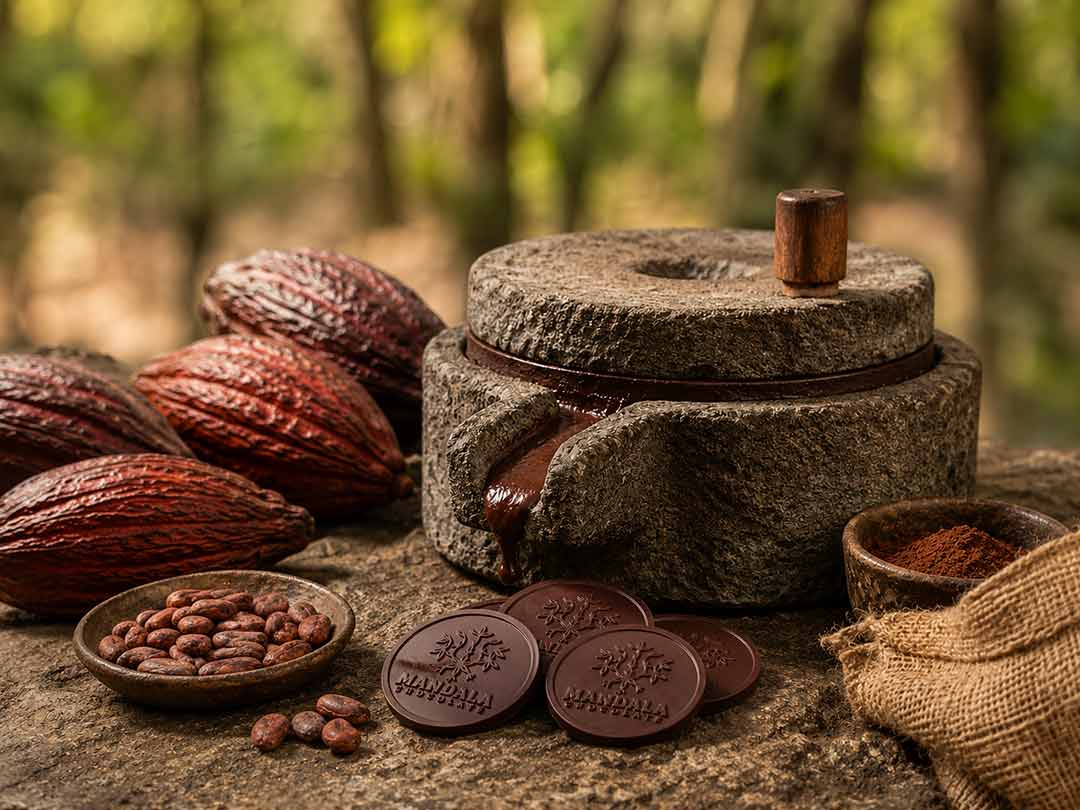
Stone melangeurs grind cacao through continuous friction between granite wheels on a granite base, a low-speed, low-heat process that preserves volatile aromatic compounds that high-temperature steel ball milling destroys. The shear force of stone grinding also distributes cacao butter differently from ball mill impact compression, producing a more uniform fat coating around each cacao solid particle. This fat distribution is the main determinant of the characteristic mouthfeel of stone-ground chocolate.
A steel ball mill works by impact and compression: steel balls rolling under pressure reduce particles rapidly and generate heat. A stone melangeur, granite wheels on a granite base, works by sustained friction and shear. The physics are different.
The lower sustained heat profile of stone grinding matters for two reasons.
First: volatile aromatic preservation. Many of the compounds responsible for cacao's flavor complexity, the fruit esters, the floral notes, the specific aromatic fingerprint of a particular origin, are heat-sensitive. High-temperature rapid refining drives some of these off as vapor. This is one reason industrial chocolate tastes generically of chocolate rather than of a specific place. Stone grinding at lower, sustained temperatures preserves more of what the origin produced. The Maya Mountain Belize character in our cacao, the bright fruit notes, the specific earthiness, survives the 6-day grind because the grind is not brutal.
Second: fat distribution mechanics. Cacao contains roughly 50% fat by weight. How that fat is distributed around the solid particles determines mouthfeel. Stone grinding's continuous shear action distributes cacao butter more evenly around each solid particle than impact-based ball milling at equivalent particle sizes. This is perceptible on the palate. It is the source of what people describe as the "smoothness" of stone-ground chocolate.
What Happens Across 6 Days
The transformation in the stone mill is not linear. It moves through distinct phases.
Days 1 to 2: Reduction and acid volatilization. The cacao mass enters the mill coarse. Grinding begins reducing particle size while driving off acetic acid and other volatile fermentation byproducts. This step is not optional. Unprocessed cacao has a sharp, near-vinegary edge. Truncating this phase leaves sharpness in the finished chocolate that cannot be removed chemically. Time and friction remove it.
Days 2 to 4: Fat integration. As particle size decreases, cacao butter is progressively released and redistributed around the solid particles. By day 4 the texture is smooth by most craft standards. The flavor is not yet what it will be.
Days 4 to 6: Flavor coherence. The processing artifacts, the sharpness, the dissonance between individual flavor compounds, resolve into a unified flavor. What remains is the cacao itself: the origin character, the varietal signature of Maya Mountain Belize Trinitario beans after 6 days of patient attention. The harshness is gone. The complexity remains.
When other ingredients are added at the 72-hour mark, adaptogenic botanicals, yacon syrup, wild-harvested herbs, the second 72-hour phase integrates them into the cacao matrix at a level of homogeneity that shorter processing cannot achieve. The result is not cacao with things in it. It is a unified material.
Three Sensory Outcomes of Extended Grinding
Six-day stone-ground chocolate produces three sensory characteristics distinguishable from even premium 48-hour craft chocolate: a continuously uniform melt from solid to liquid with no graininess, produced by extremely consistent particle size and even fat distribution; an extended flavor finish resulting from controlled compound release during the melt; and a rounded, non-spiking bitterness produced by uniform particle size rather than uneven populations that burst bitterness under tooth pressure.
The melt. Stone-ground chocolate at very fine, very uniform particle size melts at body temperature continuously. No texture interruption. This is a function of two things together: particle size (very small) and fat distribution (very even). When every particle is uniformly coated with cacao butter, the melting process is smooth because the butter coating releases each particle into the liquid uniformly. This cannot be replicated with additives or emulsifiers. It comes from the grinding.
The finish length. Flavor duration in chocolate correlates with controlled compound release during the melt. Very fine, evenly coated particles release flavor compounds slowly and continuously as they melt. Our chocolate has a finish that most people have not experienced in chocolate before, a persistence past the moment the chocolate is gone. It is a consequence of the process.
The bitterness character. Less well-ground cacao has uneven particle size distribution: some particles fine, some coarser. The coarser particles deliver bitterness in bursts as tooth pressure breaks them. Very fine, uniform stone-ground cacao delivers bitterness as a continuous, integrated note throughout the melt, not in spikes. Our chocolate is bitter. That bitterness is smooth rather than sharp. The distinction is the grinding.
What 6-Day Grinding Costs
Six days of stone grinding is expensive in predictable ways. The mill runs continuously. Throughput is low: a stone melangeur cannot be rushed. The capital cost is significant, and the Craftory in Barnardsville, NC is built around this process, which constrains batch sizing and production scheduling.
This is why most chocolate producers do not do it. The economics of scaling a 6-day grind are difficult. We have chosen not to scale past what the process allows, rather than compress the process to accommodate volume.
At $9.85 for a 2.2-ounce bar, Mandala is not cheap chocolate. The comparison to convenience-store chocolate is not the right comparison. What we are doing in Barnardsville is categorically different work.
Rob Lenfestey is the founder of Mandala Naturals, LLC, and has operated the Mandala Chocolate Craftory at 445 Stoney Fork Road, Barnardsville, NC since 2008. Every bar of Mandala chocolate is stone-ground for 6 days from single-origin Maya Mountain Belize cacao sourced through Uncommon Cacao.
Frequently Asked Questions
❓ What is stone ground chocolate?+
Chocolate refined using granite melangeurs, stone wheels rotating on a stone base, rather than high-speed steel ball mills. The process is slower and lower-heat, producing different fat distribution and flavor outcomes. Extended stone grinding (24 hours or more) is characteristic of single-origin craft chocolate producers.
❓ How long does Mandala grind their cacao?+
6 days total: 72 hours of cacao alone on the stone mill, then 72 hours after other ingredients are added. Standard craft chocolate runs 24 to 72 hours total.
❓ Is longer grinding always better?+
Up to a point, yes. Extended grinding reduces particle size, drives off fermentation acids, and develops flavor coherence. Beyond a certain threshold, continued grinding can drive off volatile aromatic compounds that make the chocolate interesting. Six days is where we've found the right balance for our cacao and formulations.
❓ What is the difference between stone grinding and ball milling?+
Stone melangeurs use granite wheels with continuous rotational friction at relatively low sustained temperatures. Ball mills use steel balls in a rotating drum, grinding by impact and compression at higher temperatures and speed. Ball mills are faster and scale more easily. Stone melangeurs preserve more aromatic complexity at extended run times and produce different fat distribution. Similar particle sizes, different mechanisms, different sensory outcomes.
❓ Why doesn't everyone grind chocolate for 6 days?+
Throughput and economics. Six days of continuous grinding per batch constrains production volume and increases operating costs. Most chocolate producers, including excellent craft producers, optimize for throughput. Mandala optimizes for the product. These are incompatible strategies at scale.
More from the Blog
Continue exploring cacao wellness